As digital dentistry continues to advance rapidly, CAD/CAM milling has become the dominant manufacturing process for dental restorations. Whether for implant abutments, full-arch bridges, or custom prosthetics, the demands placed on milling materials in terms of consistency, dimensional accuracy, and mechanical properties have grown significantly.
At Bokang, we receive similar enquiries from dental milling laboratories around the world nearly every week:
Why does one batch of dental titanium discs mill perfectly, while the next causes chipping, surface discoloration, dimensional deviation, or unstable clamping — even with identical specifications?
After years of serving dental CAD/CAM laboratories worldwide, we have found that most problems do not originate from the milling equipment itself — they stem from inconsistent material quality. The factors that most directly affect milling performance typically come down to three areas:
Many laboratories focus primarily on price during procurement and overlook these key parameters — the very ones that directly determine finished part quality and milling efficiency.
This article draws on our manufacturing experience to provide a comprehensive overview of material selection, dimensional tolerances, production processes, and procurement recommendations to help you select dental titanium discs suited to your CAD/CAM milling requirements.
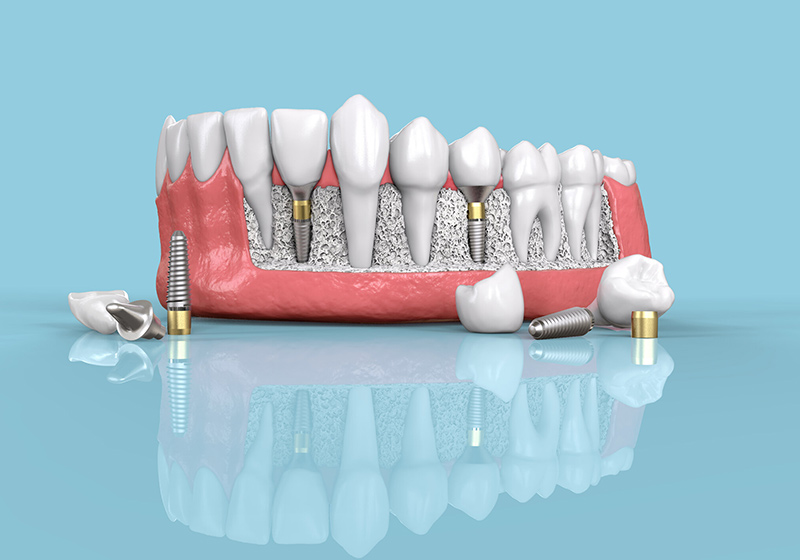
In recent years, zirconia and PMMA have been widely adopted for chairside immediate restorations. However, for implant-supported prosthetics that must sustain long-term occlusal loading — such as:
titanium alloy remains one of the most widely used materials in dental laboratories worldwide. This is because titanium offers a combination of advantages that no single alternative material fully replicates:
Approximately 3.7 million dental implant procedures are performed globally each year, and an increasing proportion of implant restorations have transitioned from traditional casting to digital CAD/CAM milling fabrication.
As the share of digitally milled restorations grows, dental laboratories' requirements for titanium disc material consistency are rising accordingly. For high-volume production, material performance stability is often more important than pursuing maximum strength alone — because only consistent material ensures that every disc delivers the same milling performance, reducing rework and material waste.
Dental titanium discs are primarily available in two material categories: commercially pure titanium (CP titanium) and Ti-6Al-4V titanium alloy. Bokang's dental titanium discs conform to ASTM F67 (commercially pure titanium) and ASTM F136 (Ti-6Al-4V ELI), among other international standards.
We recommend that laboratories select material based on the restoration's clinical application and load-bearing requirements — not price alone.
Grades 1 through 4 all belong to the commercially pure titanium family. The primary differences between them are the permitted levels of oxygen and iron content, which produce progressively higher strength and lower ductility as the grade number increases:
CP titanium delivers good cutting performance and surface finish quality, making it well suited for full metal crowns, fixed bridges, removable denture frameworks, and restorations with relatively lower strength demands. For these applications, milling efficiency and surface quality are typically more important than maximum strength.
Grade 5 is one of the most widely used medical titanium alloys. The addition of aluminum and vanadium raises its tensile strength to approximately twice that of CP titanium while maintaining good corrosion resistance and machinability. Grade 5 is widely applied in implant bridges, custom abutments, high-load implant restorations, and various CAD/CAM medical device components — and currently represents the highest-demand dental titanium disc material in the market.
Grade 23 is the Extra Low Interstitial version of Grade 5 and one of the most widely used materials in high-end implant restorations. Compared to standard Grade 5, it imposes tighter limits on interstitial elements including oxygen, nitrogen, carbon, hydrogen, and iron. Under ASTM F136, the maximum oxygen content is 0.13 wt% and the maximum nitrogen content is 0.05 wt%.
Lower interstitial element content delivers higher fracture toughness, superior fatigue performance, and longer long-term service life. For implant restorations that must sustain millions of chewing load cycles over many years, long-term fatigue performance — not initial static strength — is typically the determining factor in product longevity.
We therefore generally recommend Grade 23 for high-end custom abutments, long-span bridges, and full-arch restorations.
For dental laboratories that produce both conventional crown-and-bridge work and implant-supported restorations, we typically recommend stocking both CP titanium and Grade 23 rather than using Grade 5 for all applications. This combination better addresses the full range of clinical case requirements while managing overall procurement cost.
For CAD/CAM digital milling, material dimensional accuracy directly affects equipment clamping stability, milling consistency, and the final precision of the restoration. Many laboratories focus primarily on grade or price when procuring dental titanium discs and underestimate the importance of dimensional tolerance. Even when material performance is identical between suppliers, unstable dimensional control can produce clamping errors, depth-of-cut deviations, and batch rework.
When evaluating suppliers, we recommend verifying not only that the product specification is compatible with your equipment, but also that the supplier can maintain stable dimensional consistency over the long term.
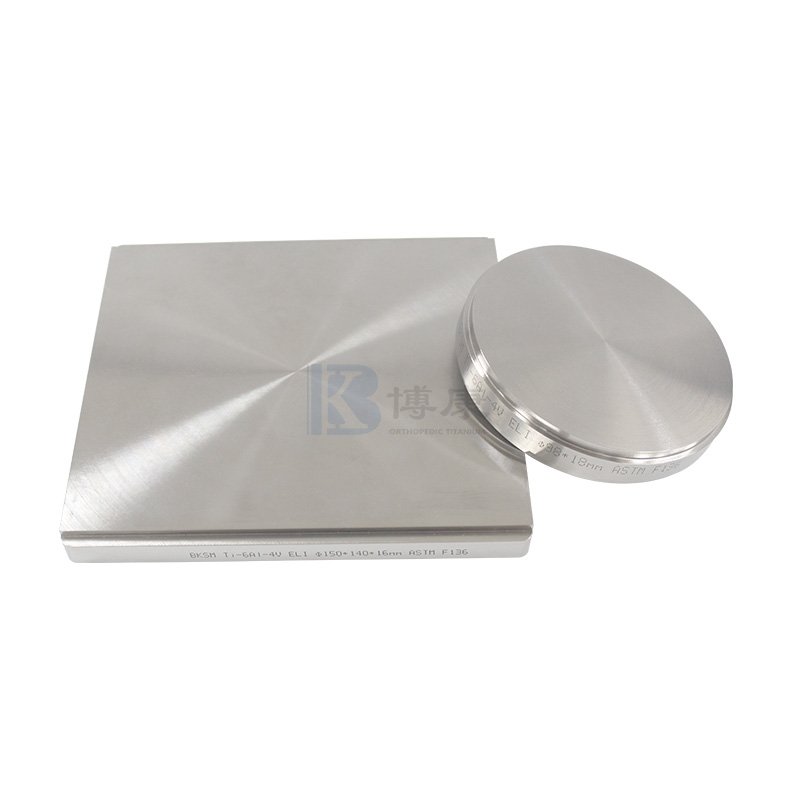
The overwhelming majority of open CAD/CAM milling systems use the Ø98 mm standard round disc, which is compatible with most mainstream equipment and open digital fabrication platforms. Bokang maintains standard dental titanium disc inventory in the following thicknesses:
These sizes cover the majority of milling requirements from single-unit restorations to full-arch implant cases and are available for prompt delivery.
For large implant bridges, multi-unit restorations, and full-arch frameworks, some laboratories prefer square blanks to improve material utilization and nesting efficiency. Bokang supplies standard square blanks in:
Thickness ranges match the round disc range and custom dimensions are available on request.
For CAD/CAM milling, what determines process stability is not only the material itself — it is whether every disc can be mounted consistently and accurately in the machine's clamping fixture. We recommend confirming the following two specific tolerance values directly with any prospective supplier, rather than accepting general descriptions like "high precision" or "precision machined."
Bokang's standard dimensional specifications are as follows:
| Product Type | Tolerance Specification |
|---|---|
| Ø98 mm Round Disc — Diameter | 0 / −0.1 mm |
| Ø98 mm Round Disc — Thickness | ±0.05 mm |
| 150 × 140 mm Square Blank — Length and Width | ±0.1 mm |
| 150 × 140 mm Square Blank — Thickness | ±0.1 mm |
Thickness tolerance deserves particular attention. If thickness control is unstable, even with identical machine parameters, the tool's depth of cut will shift between discs. When milling small quantities, this error may not be apparent; in high-volume production, the deviation accumulates progressively, resulting in restoration dimensional non-conformance, increased rework rates, and disrupted delivery schedules. By contrast, dimensionally consistent discs allow milling programs to run without frequent adjustment, improving throughput and reducing material waste.
For dental titanium discs, dimensional accuracy is the baseline requirement — surface quality also influences downstream milling. Scratches, indentations, scale, or machining marks on the disc surface can affect clamping stability, accelerate tool wear, and compromise the surface quality of the finished restoration. Bokang therefore controls not only dimensional tolerances in production but also surface flatness, surface roughness, edge chamfer consistency, disc roundness, and overall cosmetic quality. Every batch undergoes a manual cosmetic inspection before release to confirm that all products meet dental CAD/CAM milling requirements.
Beyond dimensional specifications, the material supply condition affects downstream milling performance. Bokang supplies dental titanium discs in both annealed condition (M) and cold worked condition (Y).
For the vast majority of dental CAD/CAM milling applications, we recommend annealed condition material. After annealing, the material's internal microstructure is more uniform and residual stresses are fully relieved, resulting in more stable cutting behavior during milling and better surface finish quality.
Cold worked material, while offering higher strength, retains residual internal stress. Without adequate stress relief, milling thin-walled structures or long-span frameworks can produce local distortion or warping, compromising final dimensional accuracy.
For dental laboratories, annealed condition material typically offers the best combination of milling stability, dimensional accuracy, and production efficiency, and remains the most widely used supply condition for dental titanium disc applications.
In practice, different suppliers' products may differ in unit price — but what actually drives total milling cost is material consistency, not the price per disc. Dimensional variation that causes frequent machine re-calibration, milling failures, or rework increases material consumption, reduces equipment utilization, and disrupts order delivery.
When comparing suppliers, we recommend giving at least equal weight to the following questions:
For long-term, high-volume procurement, stable product quality typically delivers a lower overall production cost — and provides a more reliable foundation for milling quality and customer delivery.
For dental titanium discs, what truly determines product quality is not only the final dimensional machining accuracy — it is whether the entire material manufacturing process is stable and controlled. Two discs that both comply with ASTM F67 or ASTM F136 can still differ significantly in milling performance and service life depending on raw material quality, melting process, forging process, heat treatment, and quality control systems. A high-quality dental titanium disc is the outcome of the entire manufacturing chain — not the result of the final machining step alone.
All Bokang dental titanium discs use high-quality titanium sponge as raw material. Titanium sponge is the fundamental input for medical-grade titanium alloy production — its purity and impurity content directly influence the downstream material's mechanical properties, microstructural uniformity, and long-term stability. The sponge is first compacted into electrodes, which are then welded in preparation for melting. Each of these steps influences final material consistency, and our quality control system begins with incoming raw material.
Melting is the critical process step that determines the quality of medical-grade titanium. Bokang uses Triple Vacuum Arc Remelting (Triple VAR) — not single-pass melting. Compared to single-melt production, Triple VAR progressively improves internal material quality through multiple remelting cycles, delivering:
These advantages are particularly important for dental restorations. Custom abutments and long-span bridges typically feature thin walls and must sustain millions of cyclic chewing loads over their service lives. If the material contains inclusions or microstructural non-uniformity, minor defects can propagate gradually, ultimately affecting the long-term reliability of the restoration. For medical-grade titanium, a stable melting process affects not only material strength but also fatigue life and long-term safety in service.
After melting, the ingot undergoes forging, heat treatment, and precision machining. Forging further refines the grain structure and improves microstructural density, providing a stable material foundation for subsequent machining. Depending on product type:
Compared to the practice of sawing discs directly from bar stock — which some suppliers use — CNC precision machining delivers significantly more stable roundness, flatness, surface quality, and dimensional consistency. For CAD/CAM milling, these details directly affect clamping accuracy and milling process stability.
Compliance with a material standard does not automatically mean that every production batch delivers stable milling performance. Every batch of Bokang dental titanium discs undergoes a complete quality inspection program before release — not simply a dimensional measurement.
Key elements including oxygen, nitrogen, hydrogen, carbon, and iron are tested to confirm compliance with ASTM F67 or ASTM F136 requirements. For Grade 23 (Ti-6Al-4V ELI), interstitial element content is strictly controlled to ensure the material delivers the required toughness and fatigue resistance.
Metallographic examination confirms that the material's internal microstructure is uniform and free from abnormal grain growth or compositional segregation, providing a reliable material foundation for downstream milling and long-term service.
Material is tested for tensile strength, yield strength, and elongation per the applicable product standard, confirming compliance with dental restoration application requirements.
Hardness directly affects milling behavior and tool wear. Consistent, appropriate hardness ensures stable cutting performance and improves milling consistency across production batches.
All products undergo dimensional measurement to verify diameter, thickness, and other key dimensions against design tolerance requirements.
Eddy current non-destructive testing is used to detect surface and near-surface defects, improving overall product quality reliability.
Internal non-destructive testing is performed to detect any subsurface defects including cracks or inclusions, further reducing the risk of internal material flaws reaching the customer.
In addition to automated inspection, every batch undergoes manual cosmetic review by quality personnel, with surface roughness measured to confirm that products meet dental CAD/CAM milling requirements.
Among all test parameters, hydrogen content is frequently overlooked — yet it is critically important for medical-grade titanium. Excessive hydrogen content can cause hydrogen embrittlement, a failure mode that typically does not manifest during milling but instead develops gradually as the product sustains sustained loading in service, eventually leading to crack initiation or component failure.
Because hydrogen embrittlement is not detectable by visual inspection, Bokang treats hydrogen content testing as a standard component of batch quality control — not an optional test charged at extra cost. We also recommend that buyers, regardless of which supplier they use, proactively confirm whether hydrogen content is tested on every batch of medical-grade titanium material, and verify that complete test records and material traceability documentation are available.
For medical-grade materials, product traceability is as important as material performance. Bokang maintains a complete batch traceability management system. Every dental titanium disc is marked with product identification traceable to:
If a customer needs to query historical production information, the corresponding manufacturing and inspection data can be quickly located. Upon request, we can provide:
These documents contain the chemical composition, mechanical property results, and test data corresponding to each specific product batch, satisfying documentation requirements for medical device qualification, dental laboratory quality management, and international trade compliance.
Bokang's CP titanium and Ti-6Al-4V dental titanium discs are widely used across the following digital dental restoration product categories:
As digital dental fabrication technology develops, an increasing number of laboratories are seeking to consolidate onto a unified material platform to improve throughput and reduce performance variation between production batches. Material consistency and repeatability of milling performance are therefore becoming increasingly important procurement criteria.
In addition to standard products, Bokang provides OEM / ODM customization services for customers worldwide. Available customization options include:
All customization is completed during the production process rather than by modifying finished parts as secondary operations, ensuring that product quality and dimensional accuracy remain consistent throughout. For new product development projects, we can also evaluate material options and provide trial samples for validation testing based on customer drawings, technical specifications, or reference samples.
Different suppliers' product descriptions may look similar on paper, but the details that most directly affect milling quality and long-term supply stability are often the ones easiest to overlook. Before confirming a bulk procurement order, we recommend addressing the following five questions.
Confirm that products conform to ASTM F67 (CP titanium), ASTM F136 (Ti-6Al-4V ELI), or ISO 5832-14, as applicable. Ask the supplier to specify the exact material grade rather than simply stating "medical titanium" or "dental titanium."
For long-term supply relationships, sample validation before committing to bulk orders is strongly recommended. Actual milling trials allow a more direct evaluation of milling performance, surface quality, tool wear behavior, dimensional stability, and post-milling polishing results. Sample validation is significantly more effective at reducing procurement risk than relying on specifications alone.
Confirm whether the supplier can provide EN 10204 3.1 Material Certificates, Mill Test Reports (MTR), and batch traceability records. For the medical device and dental industry, comprehensive quality documentation supports quality management, satisfies customer audit requirements, and facilitates regulatory compliance.
Many product descriptions use phrases like "high precision" or "premium quality" — but the information that matters is specific numbers. Ask directly for the Ø98 mm disc diameter tolerance, thickness tolerance, square blank length and width tolerance, and the supplier's demonstrated ability to maintain dimensional consistency across production batches. These figures reflect manufacturing capability more accurately than marketing language.
Delivery capability affects project schedules. Confirm in advance the lead time for standard stock items, the production lead time for custom specifications, capacity arrangements for large-volume orders, and whether the supplier supports stable long-term supply. For ongoing procurement programmes, reliable delivery is as important as reliable product quality.
Standard dental titanium discs: standard lead time 7–15 days.
Custom products: lead time generally 15–30 days depending on specification and order volume.
Single-piece sample orders are supported, enabling customers to conduct equipment compatibility testing and milling performance validation before committing to bulk procurement. For long-term customers, we can arrange safety stock and continuous supply programmes to support stable production requirements.
As digital dental manufacturing continues to advance, dental laboratories' requirements for material performance now extend well beyond standard compliance. The focus has shifted to whether different production batches remain consistent, whether milling performance is repeatable, and whether the supplier has the quality management capability and supply stability to support ongoing production at scale.
For CAD/CAM milling, a high-quality dental titanium disc must not only comply with ASTM or ISO international standards — it must also maintain long-term stability across material cleanliness, microstructural uniformity, dimensional tolerance, milling performance, and quality traceability.
At Bokang, we focus on the research and manufacture of medical-grade titanium and Nitinol alloy materials, providing dental laboratories, medical device manufacturers, and brand customers worldwide with stable, reliable material solutions. If you are currently evaluating dental titanium disc suppliers, or need guidance on selecting the most appropriate material grade for different restoration types, we are glad to offer professional recommendations based on your milling equipment, product type, and application requirements — and to provide samples for actual milling validation before formal procurement, helping you fully evaluate product performance before making a commitment.
Copyright © 2024 Changzhou Bokang Special Material Technology Co., Ltd. All Rights Reserved.
Custom Round Pure Titanium Rod Manufacturers Privacy