For decades, the success of dental implants has been rightly attributed to the biocompatibility and strength of titanium. These properties are fundamental, forming the very foundation of osseointegration—the direct structural and functional connection between living bone and the implant. However, to focus solely on strength and biocompatibility is to overlook another critical, albeit less celebrated, characteristic: fatigue resistance.
Before appreciating the role of fatigue resistance, one must first understand the complex mechanical environment an implant must endure. The oral cavity is a dynamic and demanding biomechanical system. An implant is not a static structure; it is a load-bearing component subjected to a relentless and variable cycle of forces.
The primary function of teeth is mastication, or chewing. This process generates cyclic loading, meaning the forces applied to the implant are not constant but are applied, released, and reappeared countless times each day. It is estimated that an average individual performs over 100,000 chewing cycles per year. Over a decade, this figure surpasses one million cycles, and over a typical implant’s intended lifespan of 20-30 years, the number of cycles reaches into the multi-millions. Each cycle applies a complex mix of compressive, tensile, and shear stresses to the implant structure. Unlike a single, high-force event that tests pure strength, this repeated loading presents a different challenge: fatigue failure.
The geometry of an implant system introduces points of stress concentration. Areas such as the connection between the implant abutment and the implant body itself are particularly susceptible to the accumulation of stress. Even minute, imperceptible movements at these interfaces under loading can amplify stress. Furthermore, factors like bruxism (teeth grinding and clenching) can significantly increase the magnitude and frequency of these forces, pushing the implant material to its physiological limits. It is within this context of cyclic loading and stress concentration that the inherent properties of the source titanium disc become paramount. A material that is strong but lacks fatigue resistance would be susceptible to failure under these conditions, much like a paperclip that eventually breaks after being bent back and forth repeatedly.
Fatigue resistance, in materials science, refers to a material’s ability to withstand cyclic loading without developing cracks or failing. The point of failure in fatigue occurs at a stress level significantly lower than the material’s ultimate tensile strength—the force required to pull it apart in a single, steady motion.
A key concept for implant-grade titanium is the “fatigue limit” or “endurance limit.” This is the maximum stress level below which a material can theoretically endure an infinite number of stress cycles without failing. The existence of a distinct fatigue limit is a hallmark of certain metals, including titanium and steel. For a dental implant machined from a titanium disc, this means that if the stresses experienced during normal function remain below this critical threshold, the implant has the potential to last indefinitely from a mechanical perspective. Therefore, the primary engineering goal is to ensure that the implant fatigue strength derived from the titanium disc is always higher than the stresses encountered in the mouth.
Fatigue failure is a two-stage process. The first stage is crack initiation, where microscopic cracks begin to form at the surface, often at a point of stress concentration or a minor material imperfection. The second stage is crack propagation, where these micro-cracks gradually grow with each subsequent load cycle. The quality and processing of the original titanium disc directly influence both stages. A high-integrity titanium disc with a uniform microstructure and minimal inclusions will resist crack initiation. Furthermore, a material with high fracture toughness—a property that describes resistance to crack growth—will slow down crack propagation, providing a critical safety margin.
The exceptional fatigue properties of the final implant are not accidental; they are meticulously engineered into the titanium disc from the very beginning. The choice of alloy and the subsequent processing techniques are all directed toward optimizing the microstructure for long-term performance.
The dental industry primarily utilizes two types of titanium: commercially pure (CP) grades and the titanium-6aluminum-4vanadium (Ti-6Al-4V) alloy. Each offers a distinct balance of properties relevant to fatigue.
| Feature | Commercially Pure (CP) Titanium (e.g., Grade 2, Grade 4) | Titanium Alloy (e.g., Ti-6Al-4V, Grade 5, Grade 23) |
|---|---|---|
| Primary Composition | >99% Titanium | 90% Titanium, 6% Aluminum, 4% Vanadium |
| Key Characteristic | Excellent biocompatibility, superior corrosion resistance | Higher strength, superior fatigue resistance |
| Fatigue Performance | Good, suitable for standard single-tooth implants | Excellent, preferred for smaller-diameter implants or high-stress scenarios (e.g., bruxism) |
| Microstructure | Alpha-phase | Alpha-Beta phase, which can be heat-treated for enhanced properties |
The addition of aluminum and vanadium in the alloy version creates a two-phase (alpha-beta) microstructure that can be manipulated through thermal and mechanical processing. This allows for a significant enhancement in strength and, crucially, fatigue strength compared to CP grades. For this reason, a Grade 5 or Grade 23 titanium disc is often selected for applications where maximum fatigue performance is required.
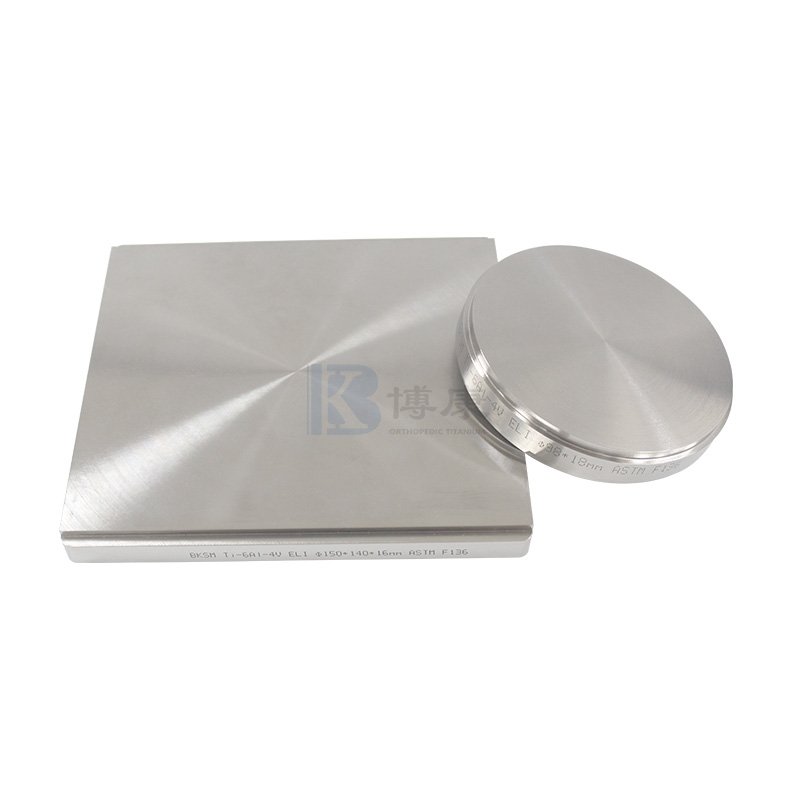
The journey of a titanium disc involves several critical steps that define its final mechanical properties. After being melted and forged into a billet, the material is often hot-rolled and then cold-rolled into a disc form. These processes work to refine the metallic grain structure. A fine, uniform grain structure is highly desirable for fatigue resistance because it creates a more homogeneous material with fewer paths for cracks to propagate easily. Furthermore, processes like annealing—a heat treatment—are used to relieve internal stresses introduced during rolling and to control the final grain size and phase distribution. The consistency of this microstructure throughout the titanium disc is critical. Any variation or defect can act as a nucleation site for a fatigue crack, compromising the integrity of every implant machined from that section of the disc.
The assurance of long-term implant success is not based on assumption but on rigorous, standardized testing. The fatigue resistance engineered into the titanium disc must be validated at both the material and the component level.
Every batch of medical-grade titanium disc must come with a material certification that verifies its chemical composition and mechanical properties, including its ultimate tensile strength and yield strength. While direct fatigue testing of every disc is not feasible, these tensile properties are strong indicators of fatigue performance. Manufacturers of the raw titanium disc perform extensive quality control, including metallographic analysis to ensure a clean, inclusion-free microstructure with the specified grain size. This provides the foundational assurance that the raw material meets the stringent requirements for medical device manufacturing.
The most critical validation occurs at the implant level. The international standard ISO 14801, “Fatigue testing of dental implants,” simulates a worst-case clinical scenario. In this test, implants are subjected to a controlled, cyclic load while immersed in a saline solution at body temperature. This test is designed to evaluate the entire implant system—including the implant body, the abutment, and their connection—under conditions that accelerate failure. Implants machined from a high-quality titanium disc must withstand millions of cycles at a predetermined load to demonstrate their safety and durability. The results of these tests directly inform the dental implant lifespan that clinicians can expect and provide the data supporting the product’s clinical use. This rigorous testing is the final, crucial link between the metallurgical properties of the titanium disc and predictable clinical performance.
The technical discussion of fatigue resistance translates directly into tangible benefits for the surgical placement and the patient’s long-term quality of life.
The high fatigue strength afforded by advanced titanium alloys allows engineers to design smaller-diameter and narrower implants. These are essential for use in areas with limited bone volume, such as the anterior mandible or for immediate placement in extraction sockets, without compromising long-term mechanical integrity. Furthermore, the ability to withstand high stresses enables the design of more sophisticated prosthetic connections. These connections can be smaller yet stronger, allowing for better preservation of the surrounding bone and soft tissue, which is critical for achieving optimal aesthetic outcomes. The reliability of the underlying titanium disc gives designers the freedom to innovate while maintaining a core focus on long-term implant stability.
For patients with parafunctional habits like bruxism, the demands on an implant can be exceptionally high. The cyclic, high-magnitude forces generated at night can rapidly accelerate fatigue damage in a substandard material. The use of an implant sourced from a titanium disc with superior fatigue resistance is a fundamental risk mitigation strategy. It provides a wider safety margin, ensuring that even under these adverse conditions, the stresses are likely to remain below the implant’s fatigue limit. This directly contributes to patient safety and reduces the long-term risk of mechanical complications. For the clinician and the patient, this means greater confidence in the treatment’s durability and a reduced likelihood of needing complex and costly repairs or replacements in the future.
While strength provides the immediate load-bearing capacity and biocompatibility enables the biological integration, it is the fatigue resistance of the source titanium disc that serves as the unseen pillar supporting the long-term success of a dental implant. It is the property that allows the implant to silently endure the millions of chewing cycles, the occasional high forces, and the subtle stresses over decades of service. From the precise control of its metallurgical composition and microstructure to the rigorous validation through international standards, every step in the life of a titanium disc is oriented toward ensuring this critical characteristic. For wholesalers, buyers, and ultimately clinicians, understanding this deep connection between material science and clinical performance is essential. It moves the conversation beyond mere strength and into the realm of enduring reliability, where the true value of a high-quality titanium disc is fully realized in a patient’s lasting smile and functional well-being.
Copyright © 2024 Changzhou Bokang Special Material Technology Co., Ltd. All Rights Reserved.
Custom Round Pure Titanium Rod Manufacturers Privacy