The journey of titanium from a raw mineral to a high-performance engineering component is a complex and meticulously controlled process. For wholesalers, buyers, and engineers, understanding the distinct stages of this supply chain is not merely academic; it is fundamental to making informed purchasing decisions, ensuring quality, and optimizing costs. The path from ore to a finished part is marked by several intermediate forms, each with its own specific characteristics, applications, and market dynamics.
Before a titanium alloy ingot can exist, the metal must first be liberated from its ore. Unlike many metals, titanium cannot be extracted simply by smelting because of its intense reactivity with oxygen and nitrogen at high temperatures. The primary ores of titanium are rutile and ilmenite, which are processed to produce titanium tetrachloride (TiCl4). The pivotal step in producing pure titanium is the Kroll process.
The Kroll process involves the reduction of titanium tetrachloride with magnesium in a sealed, inert argon atmosphere. Over several days, this reaction produces a porous, granular form of metallic titanium that resembles a sponge in both appearance and texture, hence the name titanium sponge. This material is the primary raw material for the entire titanium industry. It is not a dense, solid metal but a brittle, highly contaminated mass that must be further processed. The quality of the titanium sponge is paramount, as the levels of interstitial impurities like oxygen, nitrogen, and iron will directly influence the quality of all subsequent titanium products, including the titanium alloy ingot. This sponge is then crushed, sorted, and often blended to achieve a specific chemistry before it is consolidated into a usable solid form.
The transformation of titanium sponge into a coherent, metallic mass is the single most important step in creating a usable structural material. This is the birth of the titanium alloy ingot. An ingot is the initial cast form of a metal, and for titanium, this process is almost exclusively carried out through melting in a vacuum.
The primary method for creating a titanium alloy ingot is Vacuum Arc Remelting (VAR). In this process, pressed electrodes are manufactured from a blend of titanium sponge, master alloy powders (such as aluminum-vanadium for the common Ti-6Al-4V alloy), and sometimes recycled scrap titanium. This electrode is then placed in a water-cooled copper crucible inside a vacuum chamber. A powerful electric arc is struck between the electrode and the crucible base, melting the consumable electrode tip droplet by droplet. The molten metal solidifies in the crucible, forming a homogeneous, directionally solidified titanium alloy ingot.
The key characteristics of a titanium alloy ingot are its consolidated structure, its defined chemical composition, and its relatively large size. It is the first form that possesses the basic metallic properties of titanium. However, an ingot straight from the VAR furnace is not a finished product. Its microstructure may still be coarse, and it may contain minor chemical segregation. It is the foundational feedstock for all downstream processing. The consistent quality of a titanium alloy ingot is critical for high-integrity applications in aerospace and medical fields. The process is so crucial that for many demanding applications, the material may undergo multiple melting cycles (double or triple VAR) to ensure exceptional chemical homogeneity and a low incidence of defects.
The primary function of the titanium alloy ingot is to act as a homogeneous, chemical-compliant starting point for mechanical working. Its features are defined by the melting process.
For buyers, the certification that comes with a titanium alloy ingot is a non-negotiable document. It provides verified chemical analysis, confirming that the material meets the specified grade, such as the ubiquitous Ti-6Al-4V or other specialized alloys. This traceability from ingot to final component is a cornerstone of quality assurance in critical industries.
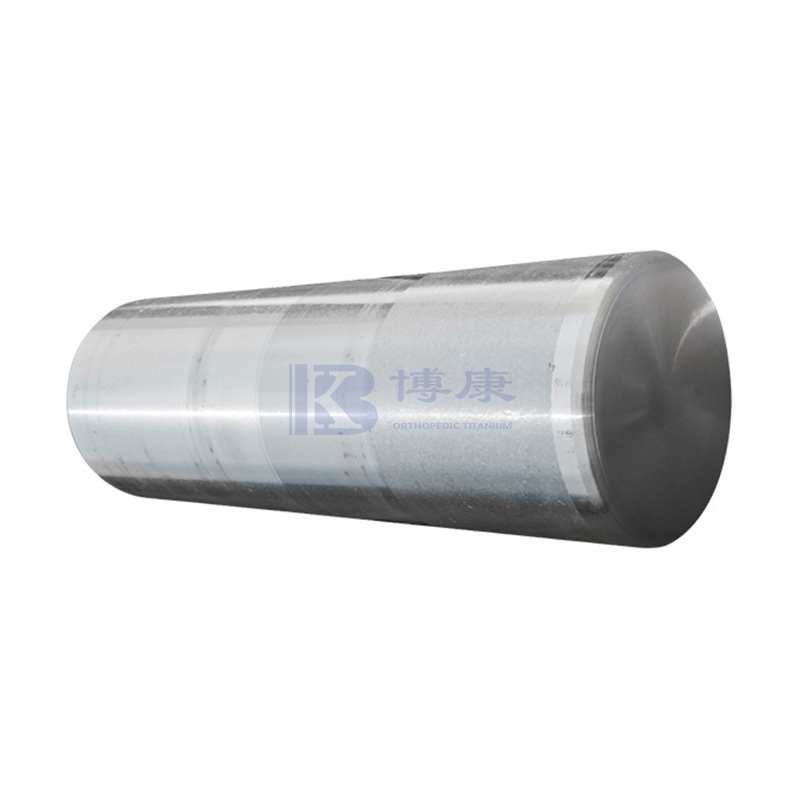
If the titanium alloy ingot is the raw, foundational block, then the billet is the refined, intermediate blank ready for precise component manufacturing. A titanium billet is produced by mechanically working an ingot through processes like forging or rolling. This working is typically performed at elevated temperatures, a practice known as hot working.
The transformation from ingot to billet is a critical one. The ingot is heated to a specific temperature where the titanium is more malleable and then subjected to compressive forces. This process, often called “cogging” or “breakdown forging,” serves several vital functions. It breaks down the coarse, as-cast grain structure of the ingot, replacing it with a much finer, recrystallized grain structure. It further consolidates the metal, healing any remaining minor porosity. It also begins to shape the material into a more manageable form, typically a square, rectangular, or round cross-section. The term “billet” usually refers to a form that is still not a final shape but is much closer to the desired dimensions of a finished part than an ingot.
The table below summarizes the key distinctions between an ingot and a billet:
| Feature | Titanium Alloy Ingot | Titanium Billet |
|---|---|---|
| Production Method | Primary melting (e.g., VAR) | Hot working (forging, rolling) of an ingot |
| Microstructure | Coarse, as-cast, dendritic | Fine, wrought, recrystallized |
| Mechanical Properties | Basic, not fully developed | Greatly improved strength, ductility, and fatigue life |
| Primary Purpose | To create a homogeneous, chemical-compliant mass for further working | To serve as a near-net-shape feedstock for machining or forging into components |
| Surface Condition | Rough, often with a scaly surface from the mold | Smoother, often machined or ground to remove surface imperfections |
For manufacturers sourcing material to make components like airframe parts or medical implants, the billet is often the most practical starting point. Purchasing a billet means the supplier has already undertaken the capital- and energy-intensive process of ingot conversion. The buyer receives a material with superior and more predictable mechanical properties. The fine-grained microstructure of a billet is essential for achieving good fatigue performance and fracture toughness in the final machined part. Furthermore, billets are available in standardized sizes and shapes, allowing for more efficient material selection and inventory management for specific component families. The ability to purchase a billet that is close to the final dimensions of the part also significantly reduces buy-to-fly ratio, a key metric in aerospace that measures the amount of raw material purchased versus the weight of the final flown part, thereby minimizing costly machining waste.
Understanding the distinctions between sponge, ingot, and billet allows a buyer to engage more effectively with the market and make strategic decisions. The choice of which form to purchase is dictated by the buyer’s role in the value chain, their manufacturing capabilities, and the end-use requirements.
A titanium sponge producer typically sells to primary metal companies that operate large melting furnaces. These companies purchase sponge, blend it to achieve the desired chemistry, and melt it into a titanium alloy ingot. The ingot is then sold either to forgers and rolling mills that will convert it into billet, bar, and plate, or directly to large OEMs who have in-house conversion capabilities. A manufacturer of final components, such as a landing gear beam or a turbine disc, will typically purchase a titanium billet or a similar semi-finished product like bar or plate. This allows them to focus their expertise on precision machining and finishing, relying on their materials suppliers to deliver a wrought product with certified and reliable properties.
The decision-making process involves several key considerations:
A discussion of titanium supply forms would be incomplete without mentioning the role of recycled material. The titanium industry has a well-established closed-loop recycling system for internally generated scrap (e.g., turnings from machining billets). This clean, chemically known scrap is a valuable feedstock and is often incorporated into the electrode for melting a new titanium alloy ingot. The use of recycled material helps to manage costs and reduce the environmental footprint of titanium production. For buyers, understanding that a titanium alloy ingot may contain a controlled percentage of recycled content is part of the complete picture, as stringent specifications ensure that this does not compromise the material’s quality or performance.
Copyright © 2024 Changzhou Bokang Special Material Technology Co., Ltd. All Rights Reserved.
Custom Round Pure Titanium Rod Manufacturers Privacy