Most Nitinol wire product datasheets lead with diameter, tolerance, and mechanical properties — but the parameter that most directly determines whether a guidewire, stent, stone retrieval basket, or actuator element will function correctly in service is frequently overlooked during procurement and design: Austenite Finish Temperature (Af).
When Af temperature is specified incorrectly:
This article provides a systematic explanation of the relationship between Af temperature and Nitinol alloy designation, along with grade selection principles and procurement verification requirements for different application scenarios.
Nitinol (NiTi) alloy wire is not a fixed-property material. It is a class of smart materials whose performance is determined jointly by chemical composition and heat treatment. Austenite Finish Temperature (Af) is the temperature at which the material completes its transformation from martensite to austenite.
When the operating temperature is above Af:
When the operating temperature is below Af:
This explains why two Nitinol wires with identical diameter and tensile strength can perform entirely differently in practice. Incorrect Af temperature specification is one of the most common — and most preventable — causes of Nitinol device failure.
The Nitinol phase transformation involves multiple temperature parameters. For procurement and design purposes, the following three are most critical:
Below Mf, the material has fully transformed into the soft, easily deformable martensitic state.
During heating, this is the temperature at which the material begins transforming from martensite to austenite.
Above Af, the material has fully transformed to austenite and exhibits complete superelasticity and shape memory effect.
Selection principle for implantable devices: For guidewires, stents, stone retrieval baskets, and similar implantable devices, the Af temperature should be significantly below body temperature (37°C), ensuring the device remains stably in the austenite phase after insertion into the body and delivers consistent superelastic performance.
Af temperature is extremely sensitive to nickel content. Research in the NiTi alloy system shows that even a very small variation in nickel concentration produces a measurable shift in Af temperature. ASTM F2063 (Wrought Nickel-Titanium Shape Memory Alloys for Medical Devices and Surgical Implants) specifies a nickel content of 54.5–57.0 wt%, a range broad enough to span multiple Af grades. For this reason, many manufacturers use internal alloy designations to subdivide the Af window.
Important: The designations below are commercially common classification examples only. They are not part of the ASTM F2063 standard, and definitions may vary between suppliers. Actual procurement decisions should be based on DSC test reports and technical agreements.
| Alloy Designation | Af Temperature (°C) | Typical Application |
|---|---|---|
| A | 70 ± 10 | Thermally actuated actuators |
| B | 30 ± 10 | Orthodontic archwires |
| S | 25 ± 5 | Stents, stone retrieval baskets |
| C | 17 ± 7 | High-plateau-stress guidewires |
| D | 10 ± 10 | High-strength guidewires, snares |
| E | 5 ± 10 | Low-temperature trigger elements |
| J / K / L | -30 to +30 (tunable) | Industrial actuators, aerospace structures |
At comparable cold work ratios and heat treatment conditions, lower-Af grades typically correspond to:
However, Af is not the sole determining factor. Final performance is also influenced by cold work ratio, heat treatment protocol, grain size, and compositional uniformity.
| Grade | Tensile Strength (MPa) | Upper Plateau Stress (MPa) | Af (°C) |
|---|---|---|---|
| D | ≥ 1300 | ≥ 480 | 10 ± 7 |
| C | ≥ 1150 | ≥ 440 | 17 ± 7 |
| S | ≥ 1000 | ≥ 400 | 25 ± 5 |
Grade selection guidance: For guidewires and core wires, prioritize Grade C or D. For stents and stone retrieval baskets, prioritize Grade S.
Working environment: human body at 37°C. Recommended Af: 5°C–25°C. Typical grades: S, C, D.
Working environment: 32°C–37°C (oral cavity). Recommended Af: 20°C–35°C. Typical grade: B.
Commercially available Af grades typically cover approximately -30°C to +30°C. This range can be extended further through composition and heat treatment adjustment.
Typical applications include deployment mechanisms, thermal control mechanisms, and vibration suppression systems. Af temperature is customized to the target operating conditions.
Stainless steel wire has long been a widely used metal material in the medical device industry. However, when a device must undergo significant bending, torsion, or compression and then recover its original shape, Nitinol's superelasticity and shape memory effect frequently make it the superior choice.
| Property | Nitinol (NiTi) Wire | Medical Stainless Steel Wire |
|---|---|---|
| Elastic recovery | 8%–10% strain | 0.2%–0.5% strain |
| Superelasticity | Yes | No |
| Shape memory effect | Yes | No |
| Kink resistance | Excellent | Moderate |
| Resistance to permanent deformation | High | Low |
| Material cost | Higher | Lower |
| Typical applications | Guidewires, stents, baskets | Sutures, core wires, fixation parts |
For structural components requiring high rigidity and low cost, stainless steel remains a reasonable choice. For devices that require repeated bending, superelastic recovery, or temperature-responsive function, Nitinol typically offers a clear performance advantage.
For precision devices such as guidewires and retrieval baskets, the following dimensional parameters are typical:
Critical process controls include: diameter consistency, residual stress management, surface roughness, and heat treatment uniformity.
Pre-order verification checklist:
ASTM F2004 defines the standard method for determining phase transformation temperatures in NiTi alloys. The industry-standard measurement technique is Differential Scanning Calorimetry (DSC), which records heat flow during controlled heating and cooling cycles to obtain the complete set of transformation temperatures: Ms, Mf, As, and Af.
A qualified supplier should provide a DSC test report for every production lot, along with chemical composition and mechanical property test reports, enabling full material traceability throughout the supply chain.
When evaluating suppliers for Af-sensitive Nitinol wire applications, the following capabilities should be assessed:
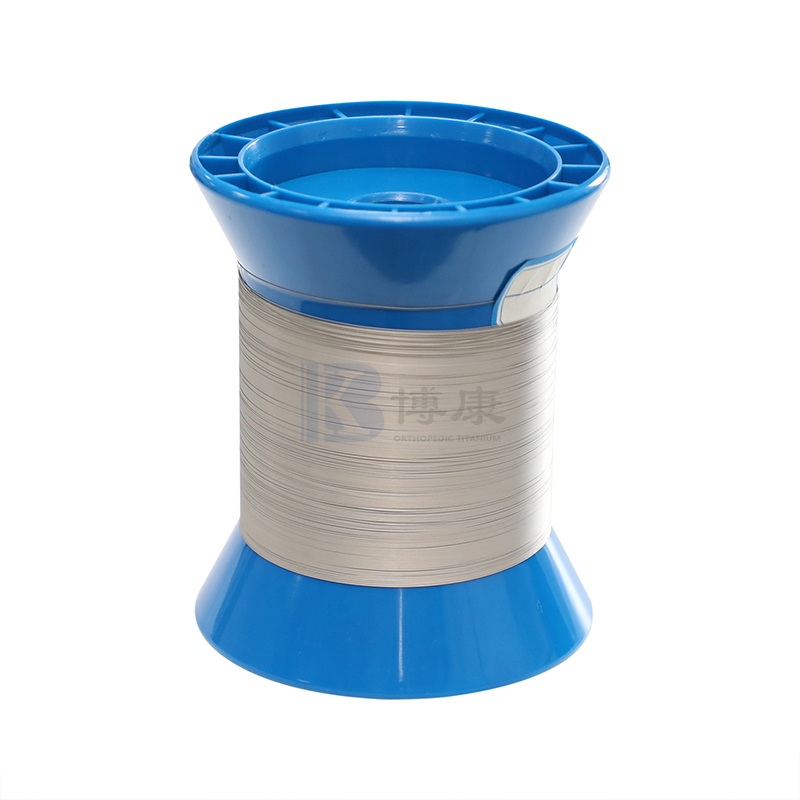
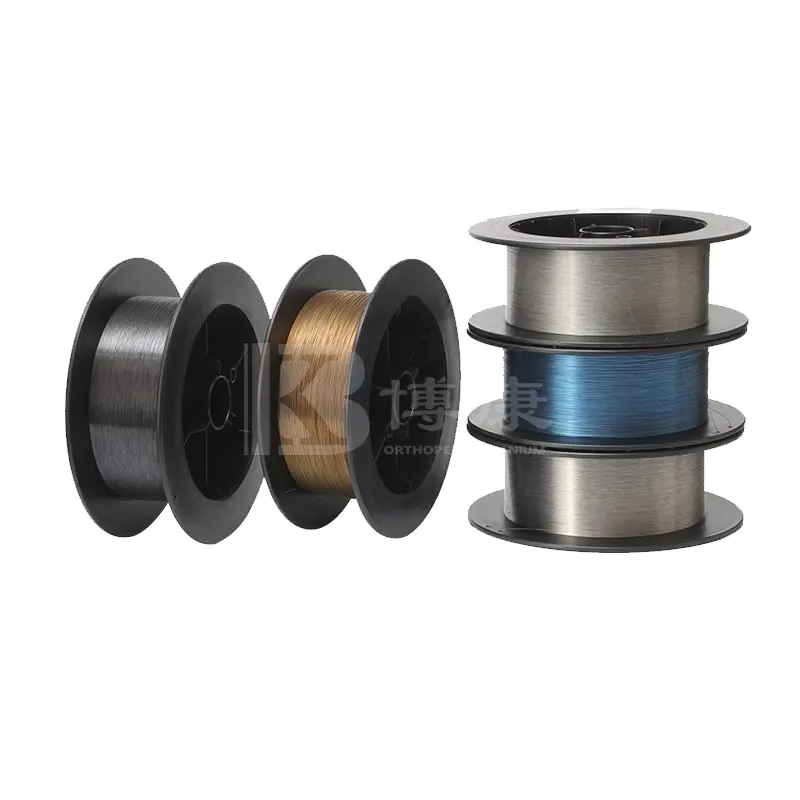
As a manufacturer specializing in medical-grade titanium and Nitinol alloy materials, Changzhou Bokang Special Material Technology Co., Ltd. supplies superelastic and shape memory Nitinol wire compliant with ASTM F2063, with support for customized Af temperature, diameter, tolerance, and surface condition specifications.
Yes. By adjusting nickel content and heat treatment protocol, Af temperature can typically be controlled across a range of approximately -30°C to +70°C. The specific achievable range depends on the material system, wire diameter, and application requirements.
When Af temperature is too close to body temperature, superelastic behavior may become inconsistent. Industry practice generally recommends specifying Af significantly below the actual working temperature to ensure the device remains stably in the austenite phase region during use.
Not necessarily. Lower Af grades typically correspond to higher plateau stress, but final performance is still strongly influenced by cold work ratio and heat treatment protocol.
Yes. For actuators, sensors, and aerospace smart structures, Af temperature is often the core design parameter that defines the actuation temperature of the finished product.
Copyright © 2024 Changzhou Bokang Special Material Technology Co., Ltd. All Rights Reserved.
Custom Round Pure Titanium Rod Manufacturers Privacy