EN
EN
 English
 日本語
日本語 한국어
한국어 Español
 عربى
عربى русский
 Deutsch
 中文简体
中文简体





Home / News / Industry News / Round vs Square Dental Titanium Discs: Applications, Differences & CAD/CAM Milling Guide

 Send Inquiry
 Send Inquiry
Titanium alloys have become an essential foundation in digital dentistry, especially for producing dental restorations and implants. As CAD/CAM milling technology becomes standard across laboratories, the shape of titanium materials-- mainly round discs and square blocks-- has gained growing importance.
Each titanium disc form lugs its own advantages in machining, device compatibility, and useful usage. Understanding exactly how they vary assists oral specialists, researchers, and medical professionals pick materials that ideal fit their tools and operations.
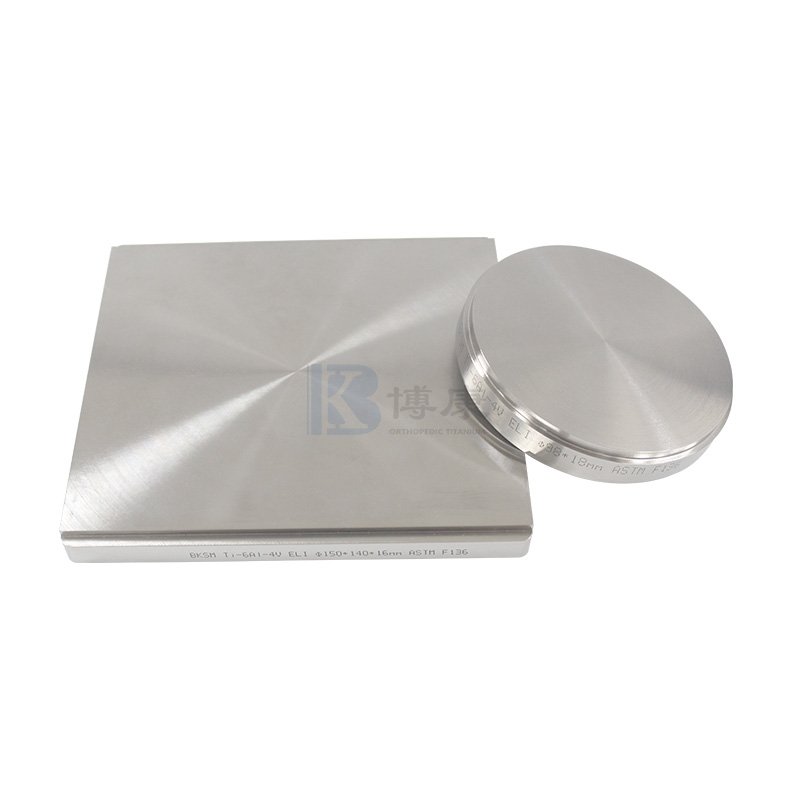
Round titanium discs are the most common format in dental CAD/CAM systems, usually available in Ø98.5 mm or Ø95 mm diameters. The standardized dimensions of the titanium disc ensure near-perfect compatibility with virtually all dental milling machines.
Its circular design guarantees smooth and balanced stress distribution during high-speed rotation, thereby enhancing precision and minimizing vibration. Edge chamfers are typically incorporated to prevent burr formation and facilitate installation.
Discs are also produced in a range of thicknesses (10-25mm), providing flexibility for restorations of different heights.
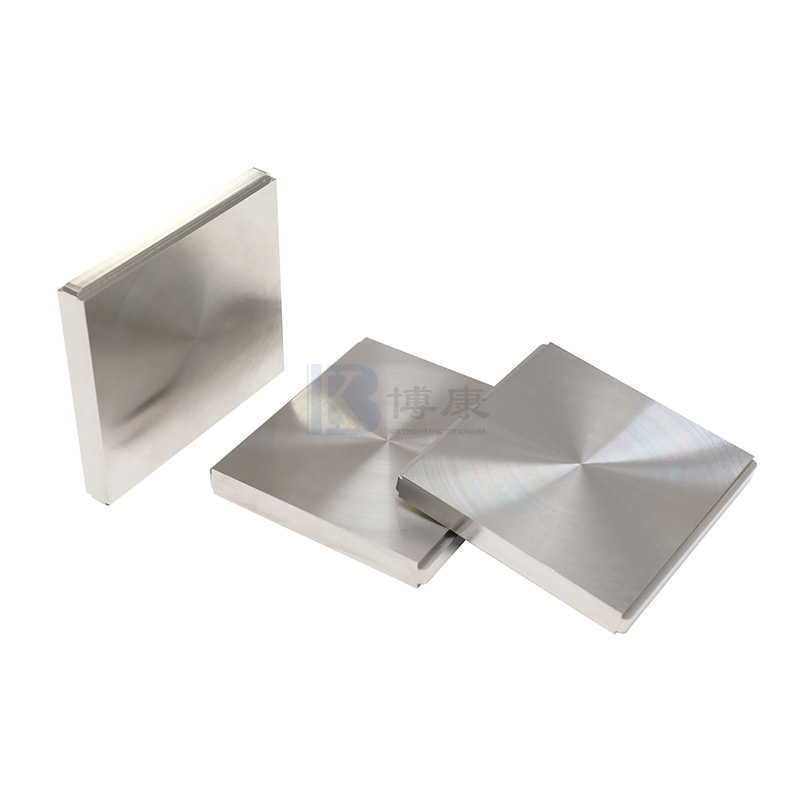
Square dental titanium discs are primarily used for restorations exceeding conventional dimensions and complexity. When restoration sizes surpass the machining limits of circular titanium discs, square titanium blocks become the critical choice. Typical applications include: full-arch implant restorations, providing comprehensive arch solutions for edentulous patients; and large specialized abutments connecting multiple implants with ultra-long-span composite bridges.
With their larger effective machining area, square titanium discs enable the monolithic fabrication of these complex structures. This approach ensures structural integrity while significantly improving material utilization.
Common sizes include 150 × 140 × H mm, 205 × 145 × H mm, and 250 × 155 × H mm.
Their rectangular structure allows more creative cutting and customized designs. Straight edges provide firm stability when fixed, which is especially useful for larger or non-standard restorations.
In storage and transport, square blocks can also be stacked more efficiently, saving space compared with round discs.
 |
 |
| Round Titanium Disc | Square Titanium Block/Disc |
Here’s the real deal with round titanium discs – they just work. Need a dental crown, dental bridge, an abutment, or an implant framework? These discs handle just about any case you throw at them. The best part? They slot right into your CAD/CAM system without any fuss. Slap it in the machine, and the whole process runs on autopilot from clamping to final cut.
For small to mid-sized labs, it’s a no-brainer. Affordable, standardized, and reliable—it’s the kind of tool that simplifies your day without demanding extra attention. You get consistency without the complication, and that’s one less thing to worry about when you’re up against the clock.
Square blocks are chosen mainly for specialized cases, such as full-arch restorations, TMJ prostheses, and R&D work. The larger surface area allows for multiple restorations to be machined in one block, improving material efficiency and reducing cost per piece.
In research, square blocks are ideal for prototype testing or experimental comparisons since multiple samples can be cut from the same piece, ensuring consistency across experiments.
Both forms-- round and square-- are produced from medical-grade titanium alloys that comply with ASTM F136 (Ti-6Al-4V ELI) and ASTM F67 (commercially pure titanium) standards.
Ti-6Al-4V ELI is the most widely used alloy in dental applications. It provides excellent strength, corrosion resistance, and biocompatibility while maintaining an elastic modulus close to natural bone.
Commercially pure titanium is used for restorations with lower strength requirements. It's easier to machine and more cost-effective.
Importantly, both round and square shapes share identical metallurgical and mechanical properties-- the only difference lies in geometry and machine compatibility.
For labs using dedicated dental milling machines, round discs are the best fit. They require no fixture modification and are optimized for plug-and-play milling.
In contrast, square blocks are more suitable for industrial-grade CNC systems or research settings where custom fixtures and flexible processing are possible.
For small or mid-volume production, round discs allow faster setup and easier material changes.
For mass production of a single restoration type, square blocks may lower costs due to better material nesting and utilization.
Round discs are beginner-friendly and come with standardized milling parameters.
Square blocks, however, demand more process control and advanced CAM programming-- best handled by experienced technicians or R&D teams.
Ensure stable clamping and optimized tool paths to minimize vibration. Diamond-coated carbide tools are recommended, along with sufficient coolant flow to prevent overheating.
When machining thin-wall areas, reduce cutting forces to avoid deformation.
These require careful fixture design and stepwise process planning. Professional CAM software helps optimize cutting paths and material layout. For large blocks, applying intermediate stress-relief or segmented milling helps maintain dimensional accuracy.
Dental titanium materials are moving toward a balance between standardized round discs and flexible square blocks. Future designs may even combine both-- such as round bases with square machining zones-- to blend convenience with adaptability.
Additive manufacturing (3D printing) is reshaping the use of titanium in dentistry. While round and square titanium stock remain the backbone of subtractive milling, titanium powder for SLM printing is rapidly expanding the options available for complex restorations.
The difference between round and square dental titanium discs lies in form and machine compatibility-- not in material quality.
Round discs offer simplicity, speed, and standardization-- ideal for most dental labs.
Square blocks deliver flexibility and efficiency for custom or large-scale projects.
As CAD/CAM and dental manufacturing continue to advance, both formats will remain essential, serving distinct but complementary roles in restorative dentistry.
Bokang Titanium has been dedicated to titanium materials for dental use for over 18 years. We manufacture round and square titanium discs with ASTM F136 and F67 standards. Each titanium disc undergoes rigorous testing before shipment to ensure consistency, strength, and biocompatibility. Our goal is straightforward—to provide reliable materials and robust technical support to dental laboratories and research teams worldwide.

Copyright © 2024 Changzhou Bokang Special Material Technology Co., Ltd. All Rights Reserved.
Custom Round Pure Titanium Rod Manufacturers Privacy